קהילת בית יוסף
Phoenix, Arizona · Since 1965
The Shul Connection
A little Torah. A little laughter. A lot of community.
ShabbosParshas Vayetzei
November 20–21, 2026 · 11 Kislev 5787
Daf Yomi Dedication
Daf Yomi for the month of Kislev is dedicated by David Goldstein in loving memory of his grandmother, Ida Herzberg גיטל בת יוסף.
May her neshama have an aliyah.
Saturday Night Family Learning
Join us Motzei Shabbos, November 21, from 7:15–8:15 PM at Beth Joseph Congregation, 515 E. Bethany Home Rd.
An evening of family Torah learning with an inspiring story, raffle and prizes, pizza, and activities for parents and children ages 4 and up!
Please bring your own learning material.
This week’s learning is sponsored by the Zalia family, l’ilui nishmas Moshe ben Shlomo.
Magen Am Arizona — Now Recruiting!
Magen Am Arizona is seeking community-minded men and women for Cohort VI (2027).
Participants will be trained to provide armed security services in support of Arizona’s Jewish community.
Interested? Visit www.magenamaz.org and click “Get Involved” to apply.
Our Thoughts and Prayers
Baruch Dayan HaEmes
We regret to inform the community of the passing of Dolly Fineman, a”h (Devorah bas Yehoshua), beloved mother of Scott Fineman.
Funeral and shiva details will be shared as they become available.
May the Fineman family be comforted among the mourners of Zion and Yerushalayim.
המקום ינחם אתכם בתוך שאר אבלי ציון וירושלים
A Word From the Rabbi
Yaakov’s Prayer
We daven three times a day- Shacharis, Mincha, and Maariv. We also have three Avos- Avraham, Yitzchak, and Yaakov. The Gemara tells us that this is not a coincidence. Avraham established that there should be prayer in the morning, Yitzchak davened in the evening, and in this week’s parsha, Yaakov instituted Maariv, the night prayer. Each one of our daily prayers was established by one of the Avos.
What’s interesting is that halachically, there is a distinction between them. While Shacharis and Mincha are both obligatory, regarding Maariv there is a debate in the Talmud, and we pasken ultimately that Maariv is a Reshus- not an obligation, but a meritorious practice. Indeed, that is why we have Chazaras HaShatz, the Repetition of the Amidah, only by Shacharis and Mincha, and not by Maariv. The original purpose of the Repetition was so those that did not know the text of the prayer could listen in and fulfill their obligations in that manner. The Sages felt that it was only necessary to institute that for those prayers that were mandatory, not those that are voluntary.
Why then, is Yaakov’s tefillah treated any less than those of Avraham and Yitzchak? This question is compounded when we realize that Yaakov is called the “B’chir She’biavos- the Chosen One of the Forefathers”! Why is his tefillah that only one that is optional?
Rabbi Yitzchak Breitowitz suggests that while the Shemoneh Esrei tefillah is identical in text, the mood and emotions through which it is expressed, changes throughout the day. The tefillah of Shacharis, recited with the rising of the sun and when the day is beginning, is a joyous, optimistic prayer. The possibilities ahead invite us to surge forward with the chirping of the birds and to conquer the world! This mirrors the life experience of Avraham who enjoyed wealth and fame, who had many thousands of followers in his lifetime that committed to serving Hashem, and who saw nachas with his wives and children (even Hagar and Yishmael ended up correcting themselves, Hagar taking on the name Keturah and Yishmael doing teshuva).
Mincha (Yitzchok) is the tefillah of concern and panic. The sun has not yet set, but the shadows grow long and the impending night looms large. It is a tefillah for continued strength and sustenance. Yitzchak himself never left Eretz Yisroel, yet the years of Galus begins from his birth. He struggles with the Plishtim who stop up the wells of Avraham, and is made to feel unwelcome. The stirrings of antisemitism begin to be felt.
Maariv (Yaakov), though, is the tefillah of the night. It is when we are sunk in Galus; when we are being persecuted and one situation after another, one decree after another, and one tragedy after another washes over us. It is when we are submerged in darkness with no idea where to turn. It represents when we hit rock bottom in our personal lives, when we have nothing left to lean on. It is a tefillah of pure Emunah. Trust that despite everything our senses tell us, Hashem loves us. That He is guiding us and sees the path ahead.
The first two tefillos, suggests Rabbi Breitowitz, are within the realm of any Jew. To turn to Hashem when things are rosy and successful, or to turn to him in panic at the turning of the tides, is completely natural and expected of everyone.
Maariv though, in the incredible bleakness of Galus- is not for everyone. It takes one with extraordinary devotion to Hashem and deep-seated Emunah to open a dialogue with Hashem through the pain. That is a level so high it cannot be required- it is an aspiration and a level that we hope to attain. It can only be instituted for those who have reached that level or act as a signpost for those on the journey.
May we all merit closeness to Hashem through all of life’s twists and turns.
Guest Voice
Standing Tall in Our Heritage
Nachshon is a lieutenant colonel in the Israel Defense Forces with 22 years of service in combat roles. A father of four, he embodies the spirit of a modern-day Maccabee. His name is a pseudonym.
Over two thousand years ago, when Shimon the Hasmonean was challenged over Jewish sovereignty in the Land of Israel, he answered with timeless clarity:
“We have neither taken other men’s land, nor do we hold that which belongs to others, but the inheritance of our fathers, which our enemies had wrongfully in their possession for a time; we, having opportunity, hold fast the inheritance of our fathers.”
Adapted from 1 Maccabees 15:33–34.
It takes a quiet, steady courage to carry that same clarity today. Whether walking into shul, reading the news, or wearing a Star of David in public, we are living through a moment when hostility toward our people and our homeland has reached levels many of us never expected to see.
When the volume of antisemitism rises, the greatest danger isn’t only the noise from outside—it is the subtle temptation inside us to shrink. To lower our voices, soften our convictions, or feel as though we must apologize for our connection to the Land of Israel.
That is precisely why holding fast to courage and self-confidence in the righteousness of the Jewish ideal matters more now than ever.
At its heart, Zionism is not a modern political invention. It is the living fulfillment of a three-thousand-year-old covenant—the simple truth that the Jewish people are a nation with an ancestral home and the fundamental right to live freely in the land of our forefathers. Just like Joshua standing at the threshold of the land, hearing the charge to be chazak v’ematz—strong and resolute—our strength has always begun with moral certainty.
Confidence in that truth does not mean ignoring challenges. It means refusing to let hostility define us. Throughout Jewish history, our survival has never depended on universal approval; it has depended on internal clarity. When we know who we are and why our bond to Israel is just, we never need to walk on the defensive.
In a community like ours, that courage is contagious. Every time we gather for Shabbat, teach our children to love Am Yisrael and Eretz Yisrael, and speak proudly of our heritage, we carry Shimon’s legacy forward. Loud hatred fades, while a people rooted in truth endures.
Let us stand firm in our path and continue writing our story with strength and pride.
Meet Our Members
Mindy, Yoni, Jack, and Wolf
Getting to Know the Dror Family
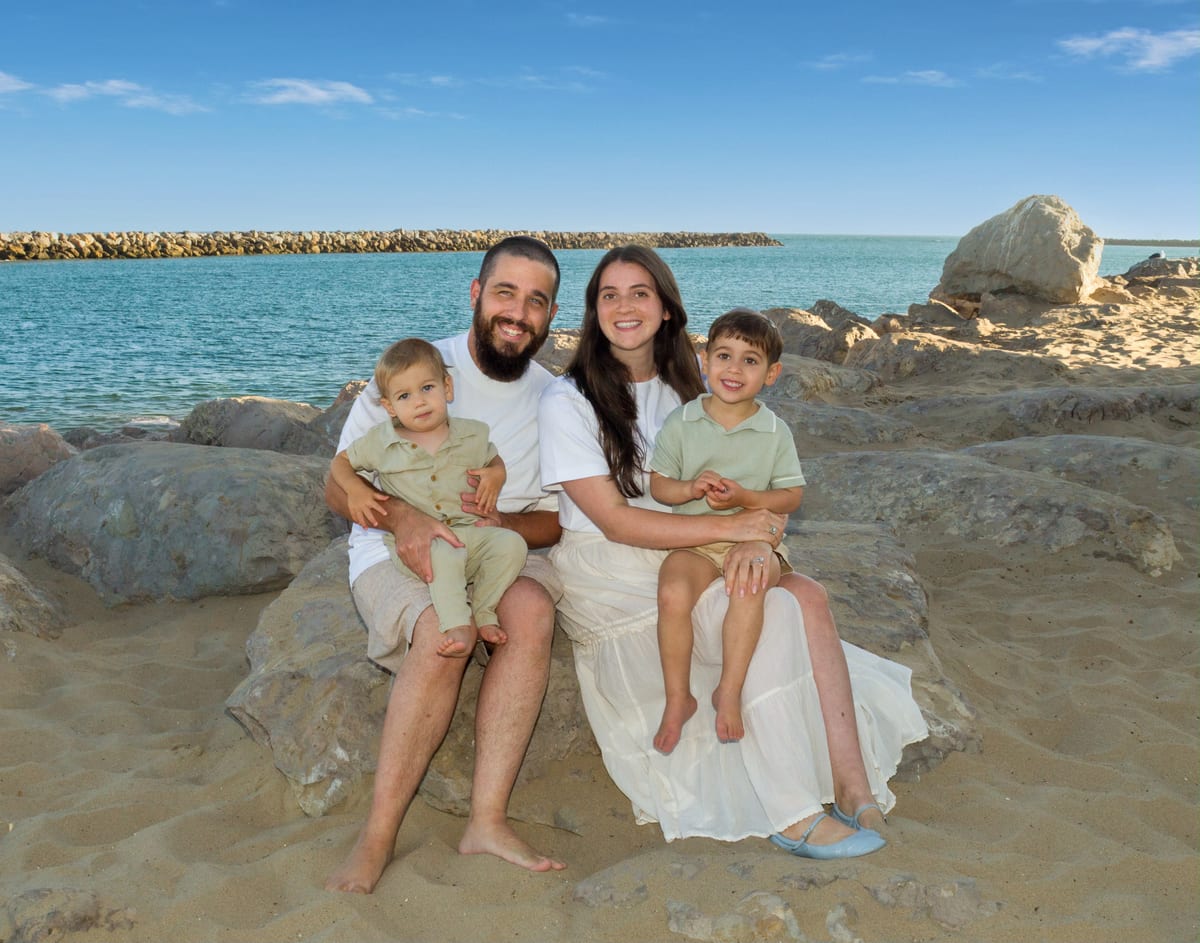
This week, we’re getting to know the Dror family! Mindy and Yoni have two young boys, Jack (3) and Wolf (22 months), and have been enjoying life in Phoenix since moving here from Los Angeles in March.
Mindy grew up right here in Phoenix, while Yoni is originally from the La Brea neighborhood of Los Angeles. Their story began when Yoni came to Phoenix for a friend’s bris. A mutual friend, Zilcha, introduced the two, and what started as a visit eventually led to something much more special!
The couple spent four years living in Los Angeles before deciding to make Phoenix their home. For Mindy, the move was a return to familiar surroundings. Having been part of Beth Joseph before moving to Los Angeles, she was happy to reconnect with the community.
Yoni works as a construction lawyer, while Mindy, who previously worked as a phlebotomist, now stays home with their two boys.
The Drors enjoy spending time together as a family, whether they’re taking walks, exploring new places, or doing a little shopping. Yoni enjoys hockey, while Mindy loves arts and crafts of all kinds.
With two young children, Mindy and Yoni are still creating their own family traditions and enjoying the little adventures along the way. One memorable afternoon involved bringing watercolors to the pool, which turned into a fun and successful family activity!
Since returning to Phoenix, the Drors have been enjoying being closer to familiar faces and building new memories together. We’re glad to have Mindy, Yoni, Jack, and Wolf as part of our Beth Joseph family and look forward to getting to know them even better.
Thank you to the Dror family for sharing your story with us!
Around the Shabbos Table
A little Parsha fun for everyone around the Shabbos table!
For Our Little Learners
- 1
What did Yaakov see in his dream while he was sleeping?
- 2
What were the names of Lavan's two daughters?
- 3
What did Yaakov put under his head when he went to sleep?
For Our Bigger Kids
- 4
What were the angels doing on the ladder in Yaakov's dream?
- 5
How many years did Yaakov work for Lavan before he married Leah?
- 6
What did Yaakov do to help Rachel when they first met at the well?
Let's Talk About It
Yaakov learned that Hashem was with him even when he was far from home. What helps us remember that Hashem is always with us?
Answers — no peeking!
1. A ladder reaching toward heaven. 2. Leah and Rachel.3. Stones4. Going up and down the ladder. 5. Seven years. 6. He rolled the large stone away from the well and watered Rachel's sheep.
Bet You Didn't Know!
Four fascinating facts from Jewish history
A Haggadah Survived More Than 600 Years of History!
The famous Sarajevo Haggadah was created in Spain during the 14th century. This beautifully illustrated Pesach Haggadah survived World War II and even the siege of Sarajevo in the 1990s. Today, it is preserved at the National Museum of Bosnia and Herzegovina.
Source: National Museum of Bosnia and Herzegovina — Sarajevo Haggadah · zemaljskimuzej.ba
America's First Jewish Cookbook Was Published in 1871!
Long before today's popular kosher cookbooks, Esther Levy published the Jewish Cookery Book in Philadelphia in 1871. Widely regarded as the first Jewish cookbook published in America, it included much more than recipes: readers could also find guidance on keeping a Jewish home, household management, and medicinal remedies!
Source: Library of Congress — From Haven to Home · loc.gov
The First Jewish Woman in Congress Was Elected in 1925!
Florence Prag Kahn of California became the first Jewish woman elected to the United States Congress in February 1925. She went on to serve for nearly twelve years and won reelection five times!
Source: U.S. House of Representatives — Florence Kahn · history.house.gov
Shanghai Became a Refuge for Thousands of European Jews!
During the late 1930s, Shanghai, China, became an unexpected refuge for Jews fleeing Nazi persecution. By the end of 1939, the city's German and Austrian Jewish refugee population had grown to nearly 17,000 people.
Source: United States Holocaust Memorial Museum — German and Austrian Jewish Refugees in Shanghai · encyclopedia.ushmm.org
A Little Laughter
The Kiddush Chuckle
A sign appeared beside the desserts at Kiddush:
“Please take one.”
After a moment of careful consideration, someone asked:
“One of each, or one trip?”
Shul Truth of the Week
You can whisper some good news to one person at shul, and somehow fifteen people are wishing you Mazel Tov before you’ve even made it to Kiddush.
The Shul Chronicles
The Great Kiddush Negotiations
Every Shabbos, the same quiet negotiations take place at Kiddush.
Someone suggests, “We should really get together for a Shabbos meal.”
“Absolutely! How about next week?”
“Oh, next week we’re away.”
“The week after?”
“We have guests.”
“What about three weeks from now?”
“That’s when my parents are visiting.”
By the time everyone’s calendars are compared, three families have joined the conversation, two possible dates have been proposed, and nobody remembers who originally invited whom.
Finally, someone smiles and says, “You know what? Let’s just make it easy. Come over this Shabbos!”
A pause.
“Wonderful! Except… we already have plans.”
And so, the negotiations continue.
This Week at Beth Joseph
Parshas Vayetzei • Nov 20 – Nov 26, 2026
Shabbos at Beth Joseph
Friday, November 20
Shacharit6:30 AM
Candle Lighting5:05 PM
Mincha/Kabbalat Shabbat/Maariv5:10 PM
Saturday, November 21 · Shabbat, Parashat Vayetzei
Shacharit8:45 AM
Recite Shema Before9:39 AM
Mincha/Maariv4:50 PM
Havdalah6:03 PM
Weekday Minyan Times
Sunday, November 22
Shacharit7:45 AM
Mincha/Maariv5:10 PM
Mon.–Wed., November 23–25
Shacharit6:30 AM
Mincha/Maariv5:05 PM
Thursday, November 26 · Thanksgiving
Shacharit7:45 AM
Mincha/Maariv5:05 PM
This week, repeat Shema every evening after 6:03 PM.
515 E. Bethany Home Rd., Phoenix · Full schedule at bjcphoenix.org/schedule
A heartfelt thank you to Erika Michel, Esty Denton, Rabbi Twerski, Elianna Gutman, and the BJC Council for their time, effort, and contributions to making The Shul Connection possible.